

01 · Chiropractic first
Spinal decompression
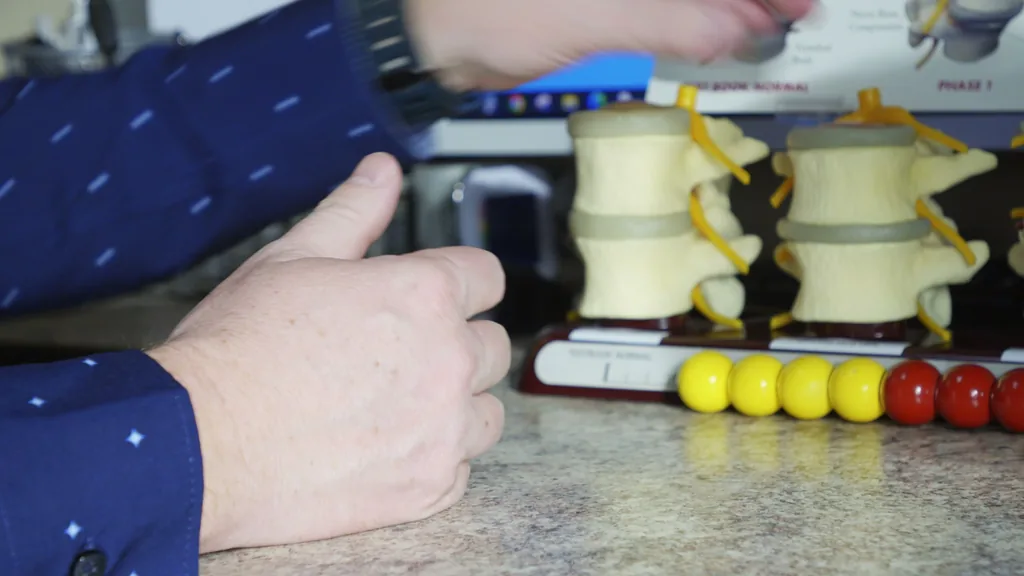
The table cycles a gradual stretch between gentle tension and relaxation and can focus on the spinal level your exam points to.
About spinal decompressionWhen your back pain starts running down your leg.
A burning line down one leg, a buttock that aches in the car, tingling in your toes.

The short answer
Sciatica is pain from an irritated or compressed sciatic nerve, felt in the low back and buttock and down one leg, often with numbness or tingling. Herniated discs, spinal narrowing and arthritis are common causes. Care at our Redmond clinic usually centers on spinal decompression, alongside chiropractic adjustments and rehab.
Sciatica can make sitting through a long drive or a round of golf the hard part of the day.
An exam looks at how you walk, where a straight-leg raise brings on the pain and how strong each leg is. The plan that follows can include spinal decompression for sciatica.
What is going on
The sciatic nerve is the largest nerve in your body. It starts in the low back, passes through the buttock and runs down the back of each leg. Sciatica is the pain that comes when something pinches, presses on or irritates that nerve or its roots, usually in one leg.
A disc, a narrowed canal or a bony change crowds a nerve root in the low back.
Pain, burning or tingling travels along its path into the leg and foot.
Coughing, sneezing, bending or a long sit can set it off again.
Tests such as an MRI usually wait unless symptoms are severe or getting worse.
Rehab opens with a functional evaluation, so later visits can be compared against where you started.
Is this what you feel?
Sciatica ranges from mild to severe.
Your list
of 8
Bring your list to the evaluation; it helps us start in the right place.
Book an evaluationWhy it happens
Several spine conditions can irritate the sciatic nerve, and in some cases no clear cause is found.
A disc that pushes out of place can press on a nerve root in the low back and send pain down the leg. It can follow a strain or build over years.
A narrowing of the spinal canal, or of the openings where nerves leave the spine, can crowd the nerve roots. It tends to come on gradually as the spine wears.
Discs and spinal joints wear over time, which is called degenerative disc disease when it affects the discs. Bone changes from osteoarthritis can also pinch a nerve.
One vertebra slips out of place on the one below it, or gradually moves out of alignment, which can stretch or press on the nerve.
Pregnancy hormones loosen the ligaments of the spine, and the growing baby can press on the nerve, so sciatica is common during pregnancy.
How we treat it
Sciatica treatment here usually centers on spinal decompression, a non-surgical way to stretch the spine gently in cycles. Your exam decides what joins it, such as adjustments, trigger point injections or coached exercise, all in one clinic with one team.
01 · Chiropractic first
The table cycles a gradual stretch between gentle tension and relaxation and can focus on the spinal level your exam points to.
About spinal decompressionAdjustments work on stiff spinal joints and the way your low back moves.
Measured X-rays guide posture work, with mirror-image adjustments, traction and exercises.
Small injections of local anesthetic and saline into tight muscle knots that guard a sore back.
Stretching and strength work that you learn in the clinic and keep doing at home.
What to expect
Sciatica often settles with time.
A short rest can help, but too much rest can make the pain worse and slow recovery.
Light movement and stretching, with coached exercises in the clinic and more to do at home.
Many cases improve within four to six weeks.
More severe cases can take several weeks or months, and the plan is reviewed with you along the way.
Your timeline depends on what is pressing on the nerve and how strong the leg still is.
Can it wait?
Do not wait
Go to urgent care or an emergency room, or call 911.
While it settles
Losing bladder or bowel control needs an emergency room or 911 right away. For the other signs, contact a medical provider today. Symptoms that do not improve after a few weeks deserve a check too.
Cost and payment
Prices are not posted online.
Each sciatica plan is built from your exam and has its own mix of visits.
In patients' own words
...They were so kind, knowledgeable, and customized a solution to help heal the damage causing my sciatica and neck pain. I regained a lot of flexibility and can now run and move with less pain!
...Then recently I have been experiencing neck, shoulder and sciatica pain! I was unable to rest, ride in a car or even relax and watch tv on my couch without severe discomfort....
A patient's story Individual results vary.
Individual results vary.
See all reviews on Google

Who you will see
Your sciatica care is led by our founder, with a second Doctor of Chiropractic on the team.
Dr. Kent Rookstool, DC, Doctor of Chiropractic and founder · Dr. Kevin Lewis, DC, Doctor of Chiropractic
Book a visit with our teamBy the numbers
3
Licensed providers on the team
Getting here
Brasada Ranch is about 22 minutes from the clinic on Highway 126, and Sunriver about 46 to 49 minutes on Highway 97.
1020 SW Indian Ave Ste 100, Redmond, OR 97756 · (541) 923-6024
Mon to Thu 9 AM to 6 PM
Your first visit
Share a brief note about where it hurts, what sets it off and how long it has been going on. We will evaluate your symptoms, discuss your goals, and explain which options may fit.
Call (541) 923-6024. Mornings or afternoons, Monday to Thursday.
We look at how your pain behaves, what movements trigger it, and what tissues may be involved.
We walk you through what we find in plain language and outline next steps that match your goals.
Not exactly. A pinched nerve can happen in many places, such as the neck, while sciatica means the sciatic nerve or its roots in the low back are pinched or irritated. Some conditions feel like sciatica yet involve nearby nerves, and an exam tells them apart.
Yes. Sitting for long periods strains the low back and can raise your risk. Break up long sits with short walks, and keep good posture in the chair and in the car.
Ice usually helps more in the first few days, when it can ease pain and swelling. After that, heat often feels better. Use either one for about 20 minutes at a time, a few times a day if it helps.
It usually affects one leg at a time, and only rarely both. Symptoms in both legs, or new weakness in either one, are worth an exam soon.
Usually, yes. Light activity such as walking keeps you flexible and strong, and it may ease pressure on the nerve. Keep the pace easy, and stop if the leg pain sharpens.
Hip problems often cause pain in the groin, or when you put weight on the leg or move the hip. Sciatic pain usually starts in the low back and travels into the hip or down the leg. Numbness, tingling and weakness point more toward sciatica.
Use good posture when you sit, stand, lift and sleep, and keep a healthy weight. Stay active with stretching and core-strength exercises, and avoid tobacco, since nicotine reduces blood flow to the spine.
Published reference lists exclude nerve warning signs, such as new leg weakness or new bladder or sexual function problems, which need prompt medical care first. The same lists rule it out in pregnancy, after a spinal fusion or with spinal hardware, and with an abdominal aortic aneurysm, advanced osteoporosis, or a broken bone, tumor or infection in the spine.
Advanced Pain Solutions
Decompression, adjustments and rehab under one roof.
Mon to Thu 9 AM to 6 PM · 1020 SW Indian Ave Ste 100, Redmond