

01 · Chiropractic first
Chiropractic adjustments
Adjustments support mobility in spinal joints that are stiff or not moving well.
About chiropractic adjustments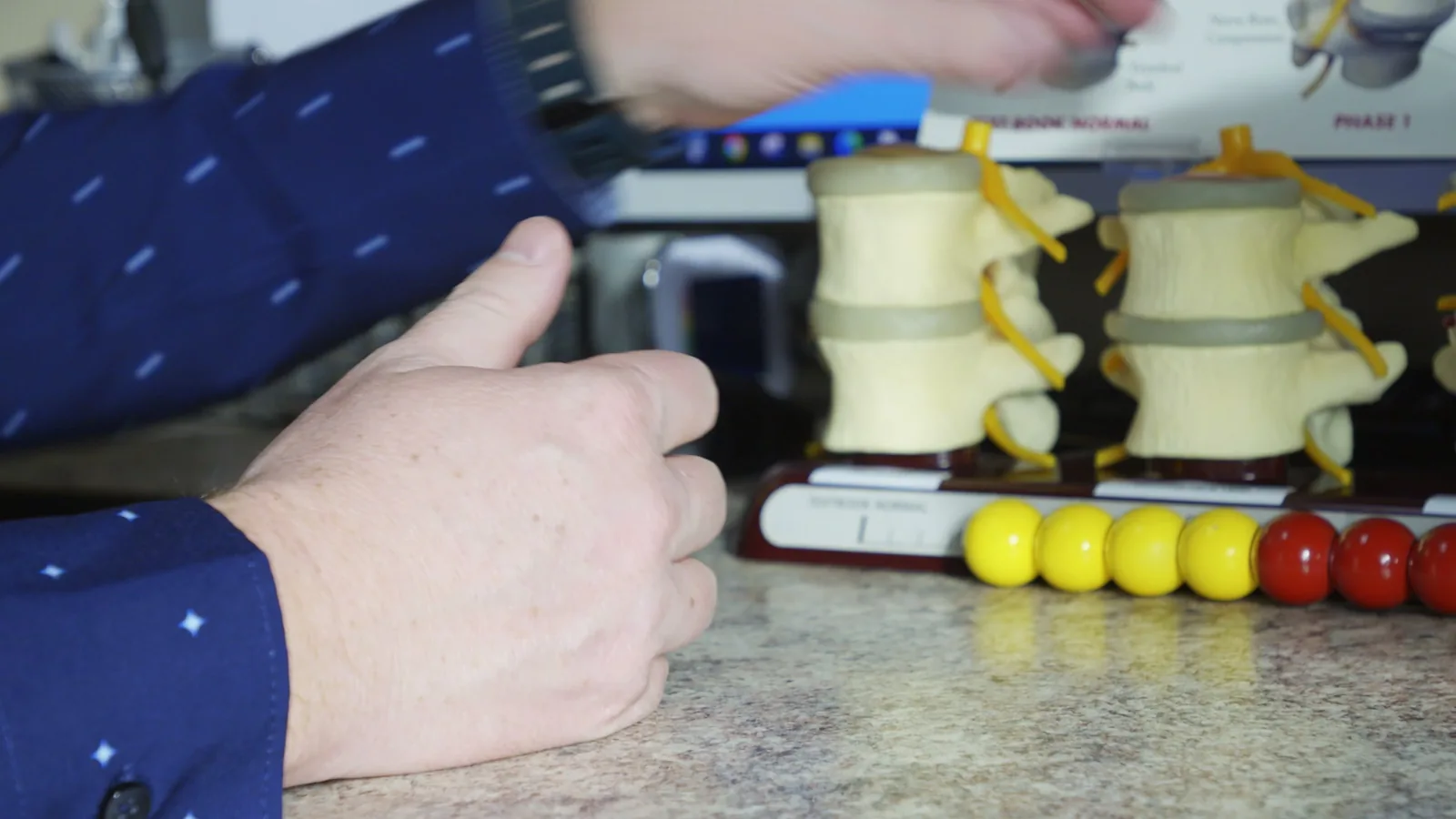
When your back starts planning your day.
Stiffness that lingers in the morning, soreness after a long drive, a flare when you get back to your routine.
A spine model in the treatment room
The short answer
Most back pain in active adults comes from strained muscles, an irritated disc, worn spinal joints, posture that loads one area too hard, or an irritated nerve. An exam in our Redmond clinic shows which. Care usually begins with chiropractic care and spinal decompression, adding guided rehab and other options.
Back pain can sneak into everything, from how long you sit at your desk to lifting groceries or heading out for a hike. You may start skipping the longer drive or thinking twice before nine holes or a ride.
We look at how your spine is aligned and how it moves under everyday load. From there, a plan may combine chiropractic adjustments for back pain with decompression or rehab.
What is going on
Your spine carries load through discs, small joints, ligaments, muscles and nerves working together. Back pain can range from a dull, constant ache to a sudden, sharp pain that shoots down the leg. It may come on after a fall or a heavy lift, or build slowly as the spine changes.
Long drives, desk days, lifting or an old injury put more stress on one part of the spine than it recovers from.
Muscles tighten and movement narrows to protect the area, while a disc or a nerve may stay irritated.
The same segments keep taking the load, so the pain returns with the same activities.
An exam, sometimes with X-rays, is how a provider tells which part of the spine is involved.
Chiropractic BioPhysics X-rays give a baseline and a target, so changes in your posture can be tracked over time.
Is this what you feel?
Back pain can sit in one spot or spread.
Your list
of 8
Bring your list to the evaluation; it helps us start in the right place.
Book an evaluation
The dashed line: where leg pain travels
Why it happens
Back pain is not always tied to one moment, and several causes can be present at the same time.
A strain injures a muscle or tendon, and a sprain the ligaments that hold the vertebrae together. Twisting or lifting the wrong way, yard work or a hard workout after time off are common triggers.
Discs are cushion-like pads between the vertebrae. An irritated or herniated disc can press on nearby nerves, causing back pain and sometimes pain down the leg.
Over time the discs break down and the small spinal joints can wear, which goes along with arthritis and a narrowed spinal canal. It may feel like stiffness after rest or an ache that builds through the day.
A desk job with poor posture, or hours in an uncomfortable chair, loads one part of the spine more than the rest. Jobs with heavy lifting, pushing, pulling or twisting add to it.
A compressed nerve can feel sharp, burning or electric, sometimes with tingling, numbness or weakness in the leg or foot. Disc problems, spinal narrowing or joint changes can cause it.
How we treat it
A back pain plan usually combines correction, options that calm pain and guided rehab you continue at home. Chiropractic care, decompression, rehab and injections all happen in one clinic, and the team shares your plan.
01 · Chiropractic first
Adjustments support mobility in spinal joints that are stiff or not moving well.
About chiropractic adjustmentsDigital X-rays measure your spinal angles and posture, then mirror-image adjustments, traction and posture exercises work toward a target.
Gentle tension, then release. A computerized table stretches the spine in cycles and can target one spinal level.
Acoustic pulses from a handheld applicator for stubborn soft-tissue pain around the low back and hips, with no needles.
Regenerative injections such as PRP, made from your own blood, can be part of a plan when your exam supports them.
Control, endurance and strength for the movements that set you off, coached by our medical assistants.
Regenerative therapies are not a cure and results vary. Some biologic products discussed here are not FDA approved for this use. Your provider will review options, risks and costs with you.
What to expect
Back pain is often described by how long it has lasted.
Your history, an exam and a movement check.
Acute back pain comes on suddenly and usually lasts a few days to a few weeks.
Pain that lasts this long is called subacute. Rehab builds strength and control, in the clinic and at home.
Pain that lasts longer than 12 weeks is called chronic, and a plan looks at each factor that adds to it.
Your timeline depends on what is irritating your back and how long it has been going on.
Can it wait?
Do not wait
Go to urgent care or an emergency room, or call 911.
While it settles
Leg weakness that is getting worse, or losing control of your bladder or bowels, needs an emergency room or 911. For the other signs, see a medical provider promptly.
Cost and payment
Prices are not posted online.
What you pay depends on your plan, such as how many adjustments, decompression sessions or rehab visits it includes.
In patients' own words
Came into APS with lower back pain that has stopped me from enjoying the outdoors over the past year. The team at APS were very friendly and informative, assisting in correcting my back issues. I am now able to enjoy weekends with my kids.
I’ve been dealing with back issues for a decade and felt like I had no hope after years of pt and chiro. After 3 months I’m gaining my life back and have had more success than ever!...
A patient's story Individual results vary.
Brian G.'s story Individual results vary.
Individual results vary.
See all reviews on Google

Who you will see
Your plan is led by the Doctor of Chiropractic who founded the clinic and has dealt with his own significant back pain.
A second Doctor of Chiropractic works alongside him.
Dr. Kent Rookstool, DC, Doctor of Chiropractic and founder · Dr. Kevin Lewis, DC, Doctor of Chiropractic
Book a visit with our teamBy the numbers
3
Licensed providers on the team
Getting here
From downtown Bend the drive is about 24 minutes (16.6 miles) on Highway 97. From downtown Sisters it is about 30 minutes (19.6 miles) on Highway 126.
1020 SW Indian Ave Ste 100, Redmond, OR 97756 · (541) 923-6024
Mon to Thu 9 AM to 6 PM
Your first visit
Share a brief note about where it hurts, what sets it off and how long it has been going on. We will evaluate your symptoms, discuss your goals, and explain which options may fit.
Call (541) 923-6024. Mornings or afternoons, Monday to Thursday.
We look at how your pain behaves, what movements trigger it, and what tissues may be involved.
We walk you through what we find in plain language and outline next steps that match your goals.
You can be evaluated after back surgery. Your provider reviews your surgery history along with your current alignment, mobility and nerve symptoms, then explains which parts of care fit you. Bring your surgery records and any imaging to your first visit.
Usually not for long. A short rest in the first day or two can help when pain is sharp, but too much rest can make the pain worse and slow recovery. Light movement and short walks help you stay flexible and strong.
Some back problems, such as an irritated disc, hurt more after sitting or standing in one position. A desk job with poor posture, or an uncomfortable chair, can add to it. Break up long sits and long drives with short walking breaks, and choose a chair that supports your back.
Yes. Kidney stones or infections, endometriosis, pregnancy and osteoporosis can all cause back pain, and so can fibromyalgia or an infection in the bones of the spine. That is one reason your first visit begins with your full history, before any treatment is chosen.
It can. Poor sleep, depression or anxiety can make back pain come more often and feel more severe. Tell your provider how you are sleeping, since that helps shape a plan that fits your week.
Sit, stand, lift and sleep in ways that support your back, and keep a healthy weight. Stay active with walking, stretching and core-strength exercises. On a hard day, choose low-impact activity such as walking or swimming over pushing through the pain.
Published reference lists rule it out during pregnancy, after a spinal fusion or with hardware such as screws or rods, and with a broken bone, a tumor or an infection in the spine, advanced osteoporosis or an abdominal aortic aneurysm. Past back surgery, severe spinal stenosis, a slipped vertebra and a blood thinner are among the reasons to check first.
From our team
Pain control clinic
When to see someone for back pain: pain lasting weeks, pain that spreads down a leg, numbness or weakness. What an exam checks at our Redmond, OR clinic.
Advanced Pain Solutions
Clearer answers and a plan that actually makes sense.
Mon to Thu 9 AM to 6 PM · 1020 SW Indian Ave Ste 100, Redmond